



Emerging Strategies in Pesticide Remediation: A Critical Review of Nanotechnology, Computational Chemistry, and Integrated Treatment Approaches
James Onyedikachi Nwagba *
Pure and Industrial Chemistry, Abia State University, Uturu, Nigeria.
Jude C. Igwe
Pure and Industrial Chemistry, Abia State University, Uturu, Nigeria.
Anthony I. Obike
Pure and Industrial Chemistry, Abia State University, Uturu, Nigeria.
Cristopher U Ahalibe
Pure and Industrial Chemistry, Abia State University, Uturu, Nigeria.
Franklin I Udorji
Pure and Industrial Chemistry, Abia State University, Uturu, Nigeria.
*Author to whom correspondence should be addressed.
Abstract
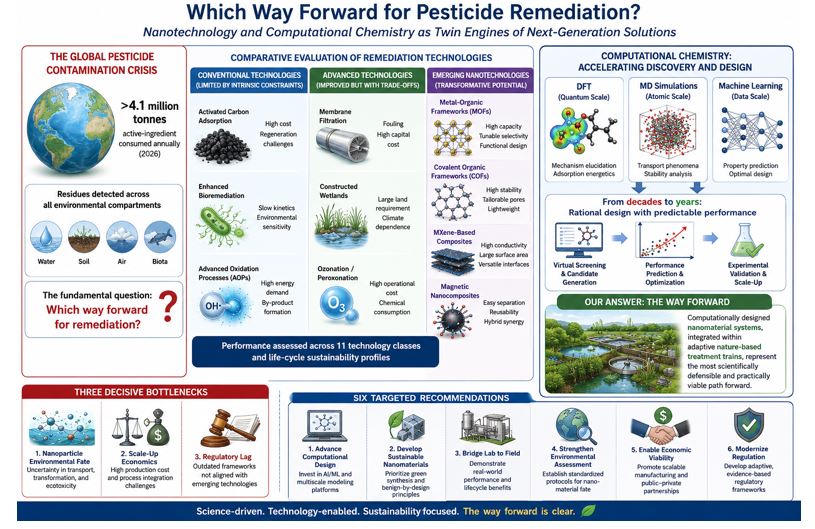
Pesticide contamination remains a major environmental challenge because residues occur across soil, surface water, groundwater, and atmospheric compartments, while pesticide classes differ widely in persistence, mobility, toxicity, and treatability. This review critically evaluates conventional, advanced, and emerging remediation technologies to identify practical treatment pathways that can address diverse pesticide contamination under economic and environmental sustainability constraints. The review compares eleven technology classes, including activated carbon adsorption, clay minerals, biological treatment, advanced oxidation processes, metal-organic frameworks, covalent organic frameworks, MXene-based composites, magnetic nanocomposites, photocatalytic nanocomposites, constructed wetlands, and integrated treatment trains. Particular attention is given to nanotechnology and computational chemistry as innovation drivers, especially the use of density functional theory, molecular dynamics, machine learning, and process-scale modelling to guide material selection, predict interactions, and support treatment optimisation. The synthesis indicates that nanomaterials can provide high removal efficiency and selectivity, especially for trace-level and chemically diverse pesticides, but their wider application is constrained by uncertain environmental fate, scale-up costs, real-matrix performance losses, and regulatory delays. Biological and nature-based systems offer stronger sustainability profiles but may be slower and less suitable for some persistent contaminants. The review concludes that the most defensible pathway is the integration of computationally designed nanomaterials within adaptive treatment trains that combine performance, sustainability, field validation, and regulatory acceptability.
Keywords: Pesticide remediation, metal-organic frameworks, MXenes, density functional theory, advanced oxidation